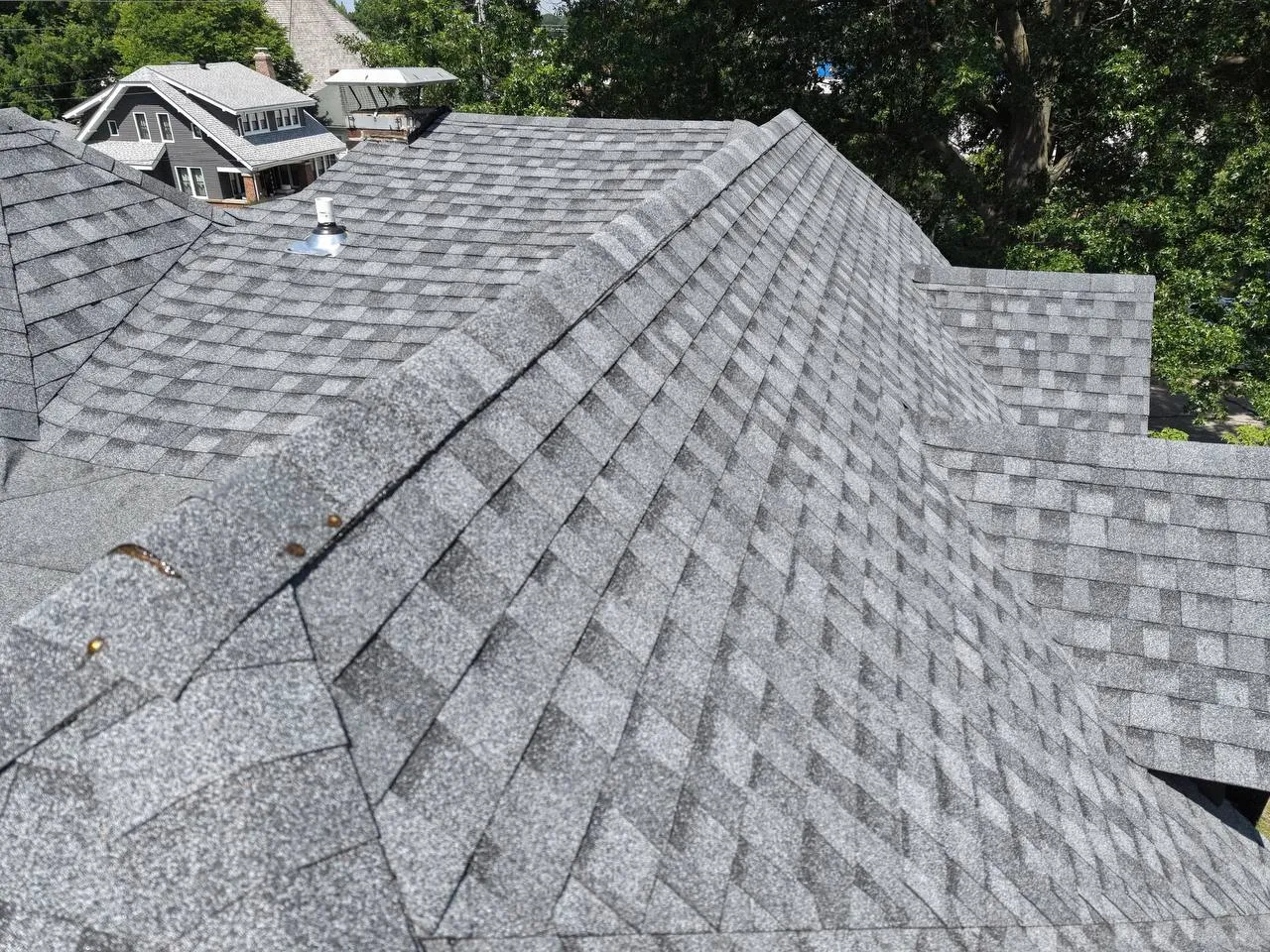
A roofing square is 100 square feet of roof surface. A typical St. Louis home has 20 to 30 squares: a 1,500 square foot ranch with a moderate pitch is about 18 to 20 squares, a 2,000 square foot two-story is about 20 to 25, and a 2,500 square foot house with a steeper roof is 28 to 35. You can get within a square or two of your own number from the ground with the footprint and a pitch multiplier, and that number is what every roofing estimate is built on.
This guide explains what a square is, how to estimate yours in ten minutes, how much waste to add, what a square costs in labor and materials in our market, and why two roofers can measure the same house and come up with different numbers.
What a Roofing Square Is
Roofers price by the square, not the square foot, because shingles are sold that way. One square is 100 square feet of installed roof. Three bundles of standard architectural shingles cover one square; a 30-square roof needs about 90 bundles before waste. Underlayment, ice-and-water shield, and labor are all quoted per square too, which is why the number matters: every square is roughly $400 to $700 installed.
Squares measure the roof's surface, not the house's floor. A roof is bigger than the floor under it because it slopes, and the steeper it is, the bigger it gets. That is the whole trick to estimating it.
How to Measure Your Roof in Squares From the Ground
You do not need to get on the roof. Three numbers, a tape measure, and a calculator get you close.
- Measure the footprint. Walk the outside of the house and measure the length and width of everything under the roof, including the garage and any covered porch. Multiply for square feet. Add the overhang: most eaves extend 1 to 2 feet past the wall on every side, so add 2 to 4 feet to each dimension. A 40 by 30 foot house with 1-foot overhangs is 42 by 32 = 1,344 square feet of footprint.
- Find the pitch. Pitch is how many inches the roof rises for every 12 inches it runs. Hold a level horizontally against the roof edge from a ladder, or against the underside of a rafter in the attic, mark 12 inches along it, and measure straight up to the roof surface. 4 inches of rise is a 4/12 pitch. Most St. Louis homes are between 4/12 and 8/12.
- Multiply by the pitch factor from the table below. A 1,344 square foot footprint on a 6/12 roof is 1,344 x 1.118 = 1,503 square feet of roof surface.
- Divide by 100 and round up. 1,503 / 100 = 15.03, so 15 squares of roof, before waste.
| Roof pitch | Angle | Pitch factor | A 1,500 sq ft footprint becomes |
|---|---|---|---|
| Flat to 2/12 | 0–9° | 1.00–1.014 | 1,500–1,520 sq ft (15 squares) |
| 3/12 | 14° | 1.031 | 1,547 sq ft (16 squares) |
| 4/12 | 18° | 1.054 | 1,581 sq ft (16 squares) |
| 5/12 | 23° | 1.083 | 1,625 sq ft (17 squares) |
| 6/12 | 27° | 1.118 | 1,677 sq ft (17 squares) |
| 7/12 | 30° | 1.158 | 1,737 sq ft (18 squares) |
| 8/12 | 34° | 1.202 | 1,803 sq ft (19 squares) |
| 9/12 | 37° | 1.250 | 1,875 sq ft (19 squares) |
| 10/12 | 40° | 1.302 | 1,953 sq ft (20 squares) |
| 12/12 | 45° | 1.414 | 2,121 sq ft (22 squares) |
If the house has sections with different pitches, such as a low-slope porch roof on a steep main roof, measure and multiply each section separately and add them up. If you cannot find the pitch, 6/12 is a safe middle guess for most homes built after 1970 in the St. Louis suburbs; older city homes and newer custom builds tend to run steeper.
How Much Waste to Add
The squares you measured are the roof. The squares you buy are more, because shingles get cut at every edge, hip, valley, and penetration, and the offcuts cannot all be reused. Roofers call the difference waste, and it depends on how complicated the roof is.
| Roof shape | Waste to add | What it looks like |
|---|---|---|
| Simple gable | 10% | Two rectangular slopes meeting at one ridge; few cuts |
| Gable with a dormer or two | 12–15% | Each dormer adds valleys and small cut pieces |
| Hip roof | 15% | Four slopes meeting at the corners; every hip is a line of angled cuts |
| Multiple hips and valleys | 15–20% | L-shaped or T-shaped homes, intersecting roof lines |
| Complex: turrets, many dormers, cut-up roof lines | 20–25% | Custom and newer builds; much of the roof is edges |
So the 15-square roof above, if it is a hip roof, is ordered as 15 x 1.15 = 17.25, rounded up to 18 squares of shingles. Starter strip and ridge cap are figured separately, by the linear foot of eaves, rakes, and ridges. A good estimate shows the measured squares and the waste factor as separate lines so you can see both.
Typical Roof Sizes by Home Size
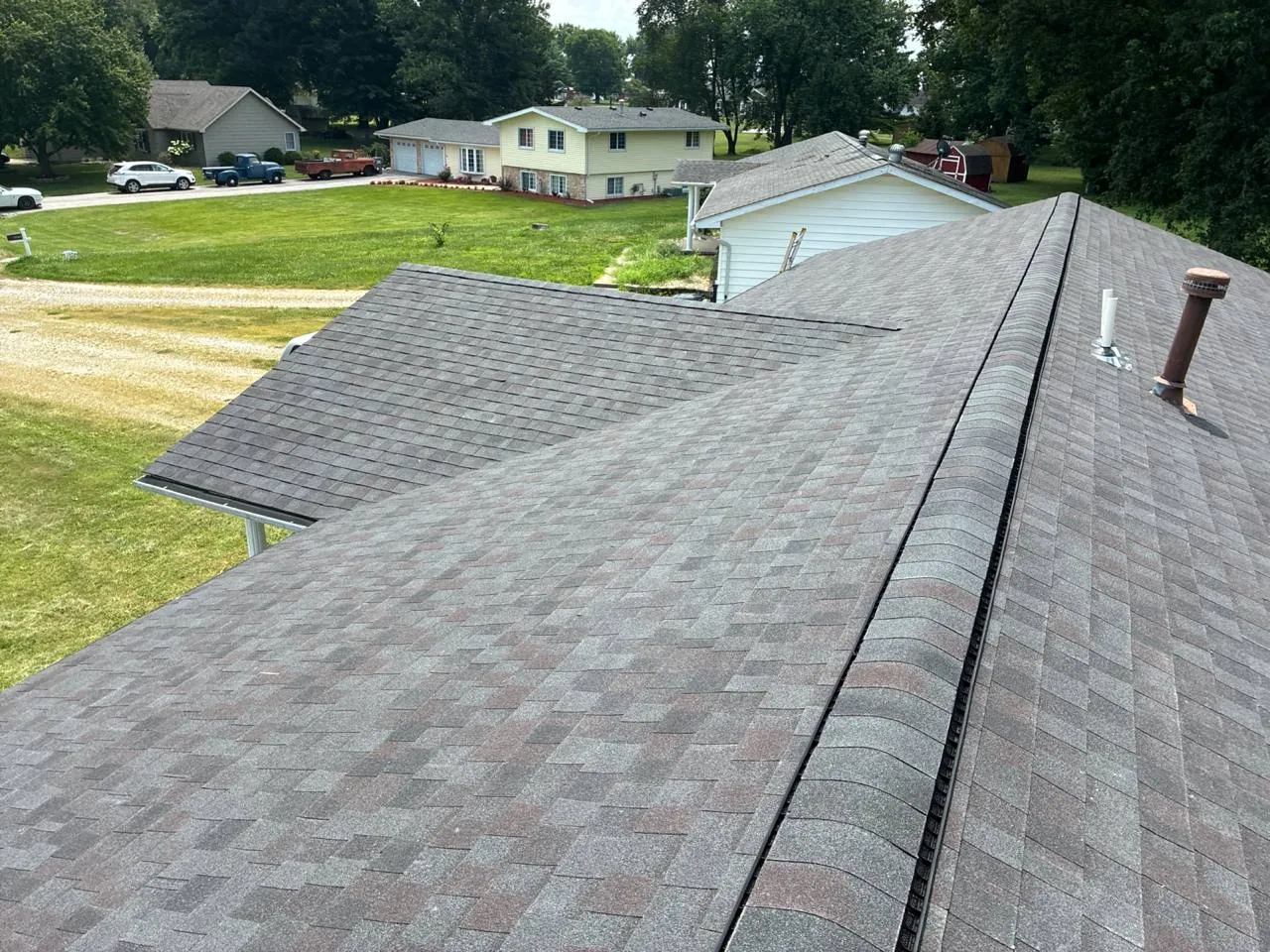
These are what we actually measure on homes around the St. Louis metro, including garages and standard overhangs, at common pitches. Your roof can land outside the range if it is unusually steep, flat, or cut up.
| Home | Living area | Typical roof squares (measured) | Ordered with waste |
|---|---|---|---|
| Small ranch, attached 1-car garage | 1,000–1,200 sq ft | 14–17 | 16–20 |
| Ranch, 2-car garage | 1,400–1,800 sq ft | 18–24 | 20–27 |
| Split-level | 1,600–2,000 sq ft | 17–22 | 19–25 |
| Two-story, 2-car garage | 2,000–2,400 sq ft | 19–26 | 22–30 |
| Large two-story, 3-car garage | 2,500–3,200 sq ft | 28–38 | 32–44 |
| Custom home, steep and cut-up roof | 3,500+ sq ft | 40–60 | 48–72 |
Notice that a two-story house often has fewer squares than a ranch with the same living area: the second floor sits under the same roof as the first. Roof size tracks the footprint, not the square footage of the house, which surprises a lot of people reading estimates.
What Each Square Costs
Once you know the squares, the estimate is arithmetic. Here is what one square of a typical St. Louis roof replacement costs today, split the way roofers think about it. The roofing material cost guide and roofing labor cost guide have the detail behind each line.
| Per square | Low | High | Notes |
|---|---|---|---|
| Shingles (architectural, CertainTeed Landmark) | $95 | $140 | 3 bundles per square; Landmark Pro $130–$175, Class 4 $150–$200 |
| Underlayment, ice-and-water shield, starter, ridge, nails | $40 | $80 | More on roofs with lots of eaves and valleys |
| Labor: tear-off, install, cleanup | $150 | $300 | Steep, high, or multi-layer roofs at the top |
| Disposal, permit, overhead | $50 | $100 | Per-square share of the dumpster and permit |
| Installed total | $400 | $700 | What a complete replacement runs per square in St. Louis |
Multiply by your squares. The 15-square hip roof above, ordered at 18 squares with waste, lands between $7,000 and $11,500 installed. A 25-square two-story is $10,000 to $17,500. For full-house ranges by size and material, see the roof replacement cost guide, and for the dollar effect of stepping up a shingle line, CertainTeed Landmark.
Why Two Estimates Show Different Squares
If one roofer says 22 squares and another says 26, nobody is necessarily lying. The number depends on what was counted.
- Measured vs. ordered. One estimate shows the roof's actual squares and lists waste separately; the other folds waste into the square count. Ask which you are looking at.
- Waste factor. 10% and 20% on the same roof is a two-square difference. The right factor depends on the roof's cuts, not the contractor's preference.
- Overhangs. Measuring to the wall instead of the drip edge undercounts a typical roof by a square or two.
- Measurement method. Satellite measurement reports (EagleView, Hover) are accurate to within a few percent and show pitch and every edge length; a tape measure from the ground is usually within 5 to 10%. We use a measurement report on every estimate so the squares are the same number no matter who writes it up.
- Separate items. Detached garages, sheds, and low-slope porch roofs are sometimes included and sometimes not. Make sure both estimates cover the same roofs.
The fix is simple: ask every contractor for the measured squares, the waste percentage, and the per-square price as separate lines. Then you are comparing the same roof. See questions to ask before signing a roof contract for the rest of the list.
Frequently Asked Questions
What is a square in roofing?
One square is 100 square feet of roof surface. Shingles, underlayment, and labor are all priced per square. Three bundles of standard architectural shingles cover one square.
How many squares is a 2,000 square foot house?
Usually 20 to 25 squares of roof, ordered as 22 to 30 with waste. A 2,000 square foot two-story has a smaller roof than a 2,000 square foot ranch, because the second floor sits under the same roof. The footprint and pitch set the number, not the living area.
How many squares is a 1,500 square foot house?
About 16 to 20 squares for a ranch with a 2-car garage at a 5/12 to 7/12 pitch, ordered as 18 to 23 with waste. Steeper roofs and hip roofs land at the top of the range.
How do I calculate how many squares my roof is?
Measure the house's footprint including overhangs, multiply by the pitch factor for your roof's slope (1.054 for 4/12, 1.118 for 6/12, 1.202 for 8/12), and divide by 100. Then add 10 to 20 percent for waste depending on how many hips, valleys, and dormers the roof has.
How many bundles of shingles are in a square?
Three bundles per square for standard architectural shingles like CertainTeed Landmark. Heavier lines such as Landmark Pro and some Class 4 shingles can run four bundles per square. A 20-square roof needs 60 to 80 bundles plus starter and ridge cap.
How much does a square of roofing cost installed?
About $400 to $700 per square installed in the St. Louis area for architectural shingles, including tear-off, underlayment, ice-and-water shield, flashing, labor, and disposal. Landmark Pro and Class 4 impact-resistant shingles add $50 to $100 per square.
How much waste should I add when ordering shingles?
10 percent for a simple gable roof, 15 percent for a hip roof or a roof with dormers, and up to 20 to 25 percent for complex roofs with many hips, valleys, and cut-up roof lines.
Do roofers measure the roof or use satellite reports?
Most use a satellite measurement report such as EagleView or Hover, which is accurate to within a few percent and lists every edge, pitch, and penetration. We use one on every estimate and walk the roof to confirm it, so the squares on our estimate match what the crew installs.
Get Your Roof Measured
If you want the exact number instead of a close one, a free inspection includes a measurement report with your roof's squares, pitch, and every edge, and an itemized estimate built on it, so you can compare apples to apples with anyone else's. Request a free inspection, or read about our roof replacement service first.