

When homeowners notice water stains on ceilings or walls, the first reaction is almost always the same: “The roof must be leaking.”
That’s a reasonable assumption. Roofs sit on top. Water falls from above. Case closed.
Except it’s not that simple.
In Missouri and Illinois, a surprising number of moisture problems don’t start on the roof at all. They start on the walls — specifically, behind siding. And when siding allows moisture in, the symptoms can look almost identical to a roof leak.
Before you schedule a full roof replacement, it’s worth understanding how siding-related moisture issues happen, how to spot them, and why they’re often misdiagnosed.
Why Siding Problems Get Blamed on the Roof
Water has a habit of traveling before it reveals itself.
Moisture that enters behind siding doesn’t necessarily drip straight down inside the same wall cavity. It can move along framing, insulation, or sheathing before showing up in places that make it look like the roof is responsible.
A ceiling stain near an exterior wall? The roof gets blamed.
Peeling paint near the top of a room? The roof again.
Musty smell in an upstairs bedroom? Still the roof.
Sometimes that’s accurate. But not always.
Siding is your home’s first line of defense on vertical surfaces. When it fails, water doesn’t announce where it entered.
How Moisture Gets Behind Siding in the First Place
Siding isn’t meant to be waterproof. It’s meant to shed water while the layers behind it manage what gets through.
Problems start when flashing is missing, sealants fail, or the drainage plane behind the siding isn’t working properly. Wind-driven rain can push water upward and sideways. Freeze-thaw cycles can open small gaps that weren’t obvious in summer.
Over time, moisture finds a path.
Once water gets behind siding, it may stay there longer than you think — especially in humid Midwest conditions. That lingering moisture is what causes the real damage.
Stains That Follow Wall Lines Instead of Roof Lines
One of the most overlooked clues that siding is involved is the pattern of interior staining.
Roof leaks often follow rafters or appear directly below penetrations like vents or chimneys. Siding-related moisture tends to show up along vertical wall seams or near windows and corners.
If staining is strongest along exterior walls and less noticeable toward the center of the room, siding deserves a closer look.
It’s not a perfect rule — but it’s a common one.
Musty Smells Without Obvious Roof Damage
Attics usually reveal roof leaks fairly quickly. Wet decking, visible drips, or clear staining patterns make the cause easier to identify.
Siding-related moisture problems are quieter. The attic may look fine. Shingles may appear intact. Yet a musty smell develops inside exterior walls.
That’s because the moisture isn’t coming from above. It’s entering behind siding and soaking into sheathing and insulation.
According to the U.S. Department of Energy, prolonged moisture exposure within wall systems can significantly increase the risk of mold growth and structural deterioration, especially when drying is limited.
https://www.energy.gov/energysaver/moisture-control
The key phrase there is “within wall systems.” Not just roofs.
Paint and Caulk Failures Around Windows
Windows are one of the most common entry points for siding-related moisture.
If exterior caulk is cracking, pulling away, or missing entirely, water can seep behind trim and siding. Over time, that moisture may appear inside near window frames or upper wall corners.
Homeowners often assume window condensation is the issue. In some cases, it is. In others, the water is coming from outside — just not from the roof.
Exterior wall penetrations deserve just as much attention as roof flashing.
Warping, Buckling, or Soft Spots in Siding
Siding doesn’t always look dramatically damaged when moisture problems start. But subtle changes matter.
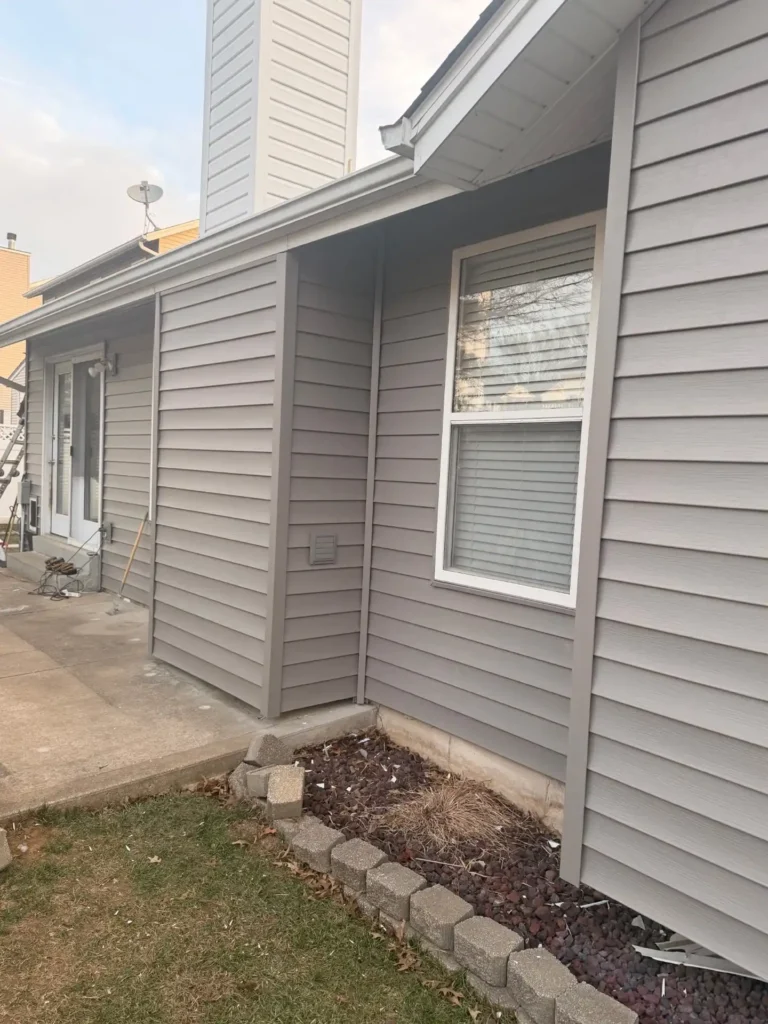
Vinyl siding may begin to warp or loosen. Fiber cement may show hairline cracks or paint blistering. Wood-based siding may feel soft in isolated areas.
These are early indicators that moisture is getting where it shouldn’t.
Waiting until panels visibly rot or detach means the underlying wall system has likely been wet for a while.
Moisture Problems That Get Worse After Wind-Driven Rain
Heavy rain straight down is rarely the biggest threat. Wind-driven rain is.
When storms push water sideways against exterior walls, siding and flashing details are tested. If moisture appears inside shortly after wind-heavy storms — even without obvious roof damage — siding is a strong suspect.
Midwest weather patterns make this especially common. Sudden storms, directional winds, and temperature swings combine to create conditions where water behaves unpredictably.
Why Freeze-Thaw Cycles Make It Worse
Missouri and Illinois winters amplify small siding weaknesses.
Moisture that enters behind siding can freeze overnight. As it freezes, it expands. That expansion widens tiny gaps. When temperatures rise again, water penetrates deeper. The cycle repeats.
Over time, minor sealing issues turn into measurable moisture problems.
This is why siding failures often show up after winter — just like roof leaks — even though the entry point is different.
When Roof and Siding Problems Overlap
Sometimes it isn’t one or the other. It’s both.
Improper flashing where the roof meets vertical walls can allow water to enter behind siding. In those cases, blaming only the roof or only the siding misses the full picture.
That’s why inspections matter. Identifying the true entry point prevents unnecessary roof replacements and ensures repairs actually solve the problem.
If moisture is suspected anywhere in the exterior envelope, a full inspection is the safest first step.

When Siding Replacement Becomes the Smarter Fix
Small moisture entry points can often be repaired. But when water has been entering behind siding for years, partial fixes rarely address the full scope.
Widespread moisture damage, recurring interior staining, or multiple failed flashing areas may signal that siding replacement is the more reliable long-term solution.
Replacing siding isn’t just cosmetic. It resets the drainage system, flashing, and moisture barrier behind the walls.
Final Thoughts: Don’t Let the Roof Take the Blame Too Quickly
It’s natural to assume water problems start at the top. Often they do. But siding failures are more common than most homeowners realize — especially in climates with wind-driven rain and freeze-thaw cycles.
If moisture symptoms don’t line up clearly with roof penetrations or attic damage, siding deserves a closer look.
The goal isn’t to blame one system over another. It’s to identify the real entry point so repairs actually fix the issue — instead of covering it up temporarily.
When in doubt, a professional inspection can determine whether your moisture problem started on the roof, behind the siding, or somewhere in between.
Clarity is cheaper than guessing.