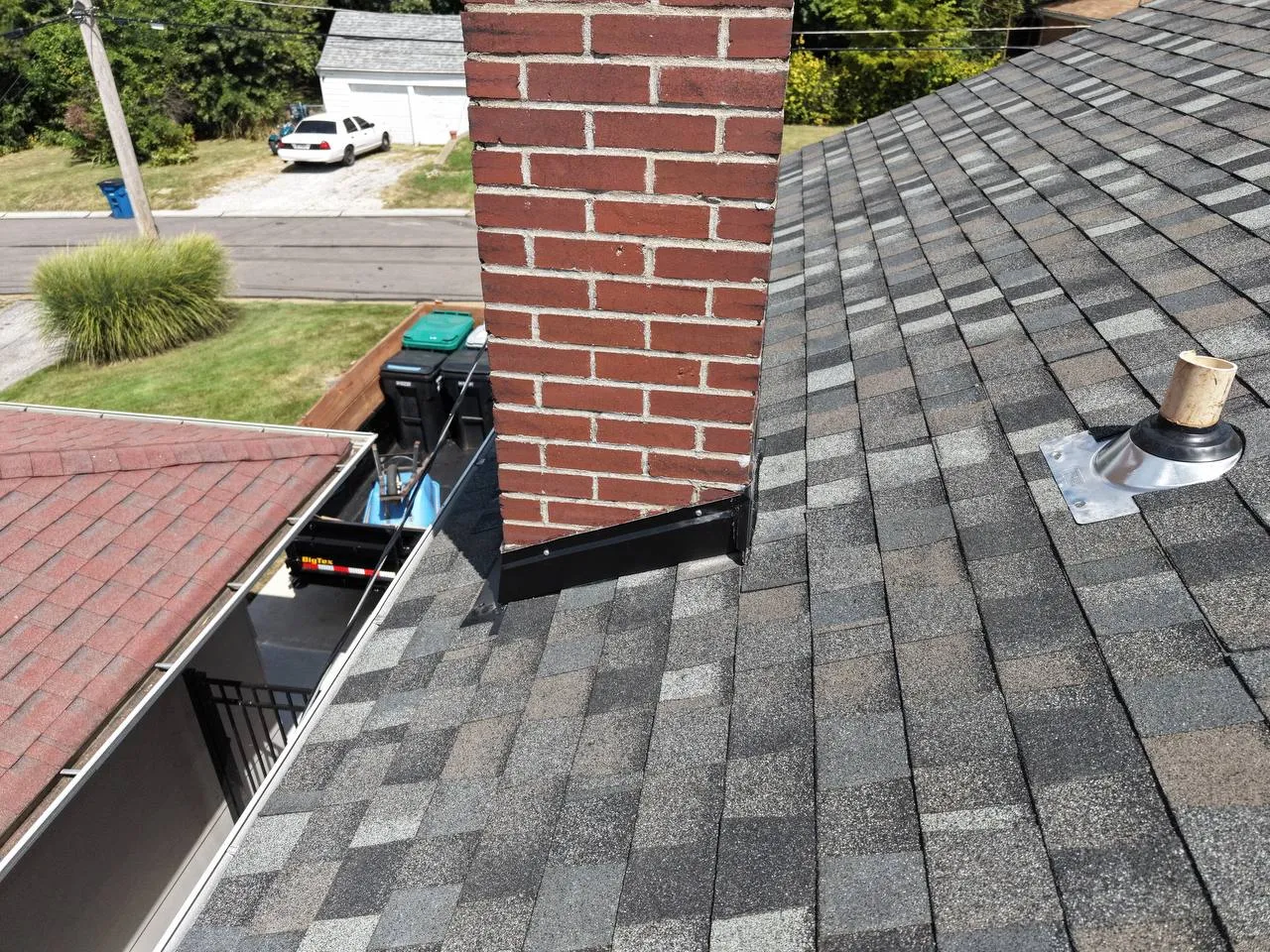
Chimney flashing is the most common single source of roof leaks we find in the St. Louis area, ahead of pipe boots, valleys, and the shingles themselves. Repairing it costs $300 to $800 if the flashing just needs resealing, $800 to $2,500 to replace it properly with new step and counter flashing, and more if the masonry needs work. The hard part is usually not the repair; it is correctly deciding whether the water is coming from the flashing at all.
This guide covers what chimney flashing is and why it fails, how to tell a flashing leak from a crown, cap, or mortar problem, what reseal, reflash, and rebuild each involve, what each costs here, and when insurance pays.
What Chimney Flashing Is
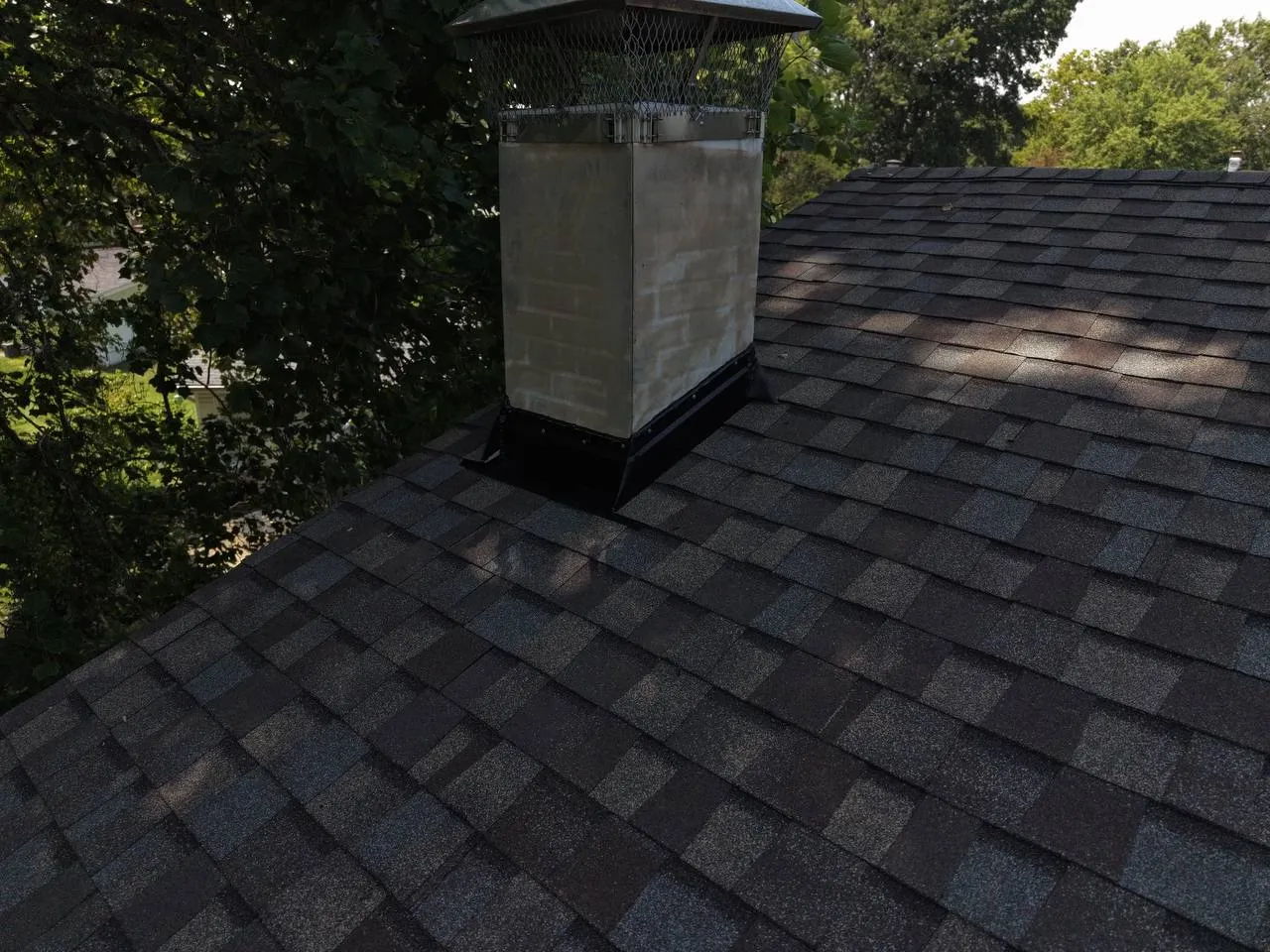
A chimney is a brick tower pushed through a hole in your roof. Flashing is the metal that seals the gap between the two, and because the chimney and the roof move differently with heat and settling, that seal is built in two overlapping pieces instead of one:
- Step flashing: L-shaped pieces of metal woven in with each course of shingles along the chimney's sides, one leg under the shingles, one leg up the brick. Water running down the roof hits the step flashing and is carried over the shingle below.
- Counter flashing (cap flashing): metal let into a groove cut in the mortar joints, bent down over the top of the step flashing. It covers the vertical leg of the step flashing so water running down the brick cannot get behind it.
- Apron flashing: the single piece across the front (downhill side) of the chimney, over the shingles.
- Cricket or saddle: on the uphill side of a chimney wider than about 30 inches, a small peaked structure that splits water around the chimney instead of letting it pool against the back. Required by code on wide chimneys; missing on a lot of older St. Louis homes.
Done right, the two layers shed water by gravity and overlap, not by sealant. Done wrong, which usually means one piece of flashing bent up the brick and caulked, the sealant is the only thing keeping water out, and sealant lasts five to ten years in our sun.
Signs the Chimney Flashing Is Leaking
Flashing leaks show up in specific places. If you see these, the flashing is the first suspect:
- Water stains on the ceiling or wall next to the chimney, usually on the uphill or side of it, that grow after heavy rain.
- Stains or dampness on the chimney brick inside the attic, especially where the roof meets the chimney.
- Rust streaks or rusted-through spots on the flashing itself.
- Flashing visibly lifted, bent, or pulled away from the brick, or a counter-flashing groove with the mortar crumbled out.
- A thick bead of roofing tar or caulk along the chimney — someone already tried to stop a leak here.
- Damp or dark shingles along the chimney's uphill side (water pooling where a cricket should be).
Check the attic first. In the attic, a flashing leak shows on the roof decking right at the chimney, usually at the corners. For the general signs, see signs of a roof leak in the attic, and for what happens if it goes on too long, mold from roof leaks.
Flashing Leak, or Something Else on the Chimney?
About a third of the "chimney flashing leaks" we are called for are not the flashing. Water can enter a chimney four other ways, and replacing the flashing will not fix any of them. Here is how to tell them apart.
| Where the water is coming in | What it looks like | Who fixes it | Typical cost |
|---|---|---|---|
| Flashing | Stains at the roof-chimney joint; wet decking at the chimney corners in the attic; worst after wind-driven rain | Roofer | $300–$2,500 |
| Chimney crown (the concrete slab on top) | Cracked or crumbling crown; water runs down inside the brick and shows up as damp brick or a stain at the ceiling, even in light rain | Mason or chimney company | $300–$1,500 to repair or recoat |
| Chimney cap (the metal cover over the flue) | Missing or rusted cap; water drips straight down the flue into the firebox | Chimney company | $150–$500 |
| Mortar joints and brick | Spalling brick faces, soft or missing mortar; brick stays wet long after rain | Mason (tuckpointing) | $500–$3,000 |
| Condensation | Dampness inside the flue with no rain; often on a chimney serving a high-efficiency furnace or water heater | HVAC or chimney liner contractor | Varies |
The quick test: if the leak shows up in light, straight-down rain, suspect the crown or cap. If it only shows up in heavy or wind-driven rain, or after snow sits against the chimney, suspect the flashing. A free roof inspection sorts it out with a hose test and a look from the roof and the attic.
Reseal, Reflash, or Rebuild: What Each Repair Involves
| Repair | What is done | When it is the right call | Lasts | Cost in St. Louis |
|---|---|---|---|---|
| Reseal | Clean the flashing, re-caulk the counter-flashing joint with polyurethane or butyl sealant, re-seat any lifted pieces | Flashing is properly built and intact; only the sealant has failed | 5–10 years | $300–$800 |
| Partial reflash | Replace the apron or the step flashing on one side, tie into the existing counter flashing | One side rusted through or damaged; the rest is sound | 15–25 years | $500–$1,200 |
| Full reflash | Remove shingles along the chimney, install new step flashing, cut a new reglet in the mortar, install new counter flashing, new apron, re-shingle | Flashing is tarred, single-piece, rusted, or was never done right; any time the roof is replaced | 25–30 years (life of the roof) | $800–$2,500 |
| Reflash plus cricket | Full reflash plus building and flashing a saddle behind a wide chimney | Chimney 30 inches or wider with no cricket; recurring leak on the uphill side | Life of the roof | $1,500–$3,500 |
| Masonry rebuild plus reflash | Mason repairs or rebuilds the chimney above the roofline; roofer installs new flashing after | Crumbling brick and failed flashing together; common on 60+ year-old homes | Decades | $3,000–$8,000 combined |
Resealing is a legitimate repair when the flashing is built right. It is a waste of money when the flashing is one bent piece of aluminum held on by tar, which is what we find on most chimneys that have leaked more than once. If a roofer's plan for your chimney is "more caulk," ask to see the counter flashing. If there is no counter flashing, the fix is a reflash.
The best time to reflash is during a roof replacement, when the shingles are already off. New flashing at every chimney is part of what a full roof replacement includes on our estimates. If an estimate says "reuse existing flashing where possible," that is where the next leak comes from.
What Chimney Flashing Repair Costs
The numbers above are for a typical single-flue brick chimney on a walkable roof. What moves the price:
- Chimney size. A wide double-flue chimney has twice the flashing and needs a cricket.
- Roof pitch. Steep roofs need staging and more time; add 20–40%.
- Metal. Galvanized steel is standard; copper looks better on a historic home and costs three to four times more.
- Masonry condition. Counter flashing needs sound mortar to seat into. Soft mortar means a mason first.
- Hidden damage. Rotted decking around the chimney runs $75–$125 per sheet to replace — see roof decking replacement cost.
For context against other common repairs, our roof repair cost guide lists what pipe boots, valleys, and shingle repairs run in St. Louis, and how contractors decide between repair and replacement covers when a chimney leak on an old roof means it is time for the whole thing.
Does Insurance Cover Chimney Flashing Repair?
Sometimes. Homeowners insurance covers sudden damage, not wear. If wind or hail bent, tore, or punctured the flashing, the repair and any resulting interior damage are usually covered, minus your deductible. If the flashing simply rusted or the sealant aged out, that is maintenance and it is on you, and so is the ceiling stain it caused. The timing matters too: a leak you knew about and left can turn a covered claim into a denied one. Our roof insurance claims guide covers the process, and wind damage vs. hail damage explains how adjusters tell storm damage from wear.
How to Keep Chimney Flashing From Leaking
- Have the flashing looked at every two years and after any hail or high-wind storm. It is part of every free inspection we do.
- Keep the chimney crown sealed and the cap in place; water from above ends up blamed on the flashing.
- Do not let anyone "fix" a flashing leak with roofing tar. It hides the problem for a season and makes the real repair harder.
- Add a cricket behind any chimney wider than 30 inches the next time the roof is open.
- Keep leaves and debris from piling up behind the chimney; standing water finds every gap.
Frequently Asked Questions
How much does it cost to repair chimney flashing?
In the St. Louis area, $300 to $800 to reseal flashing that is in good shape, $800 to $2,500 to replace it with new step and counter flashing, and $1,500 to $3,500 if a cricket needs to be built behind a wide chimney. Masonry repairs are extra.
How do I know if my chimney flashing is leaking?
Water stains on the ceiling or wall next to the chimney that grow after heavy or wind-driven rain, damp decking at the chimney corners in the attic, rusted or lifted flashing, or a thick bead of tar along the chimney from a past repair. If the leak also shows in light rain, check the crown and cap first.
Can you repair chimney flashing without replacing the roof?
Yes. A roofer removes the shingles along the chimney, installs new step and counter flashing, and re-shingles that area. It is a half-day job on most homes. If the roof is within a few years of replacement anyway, it is cheaper to wait and reflash during the replacement.
Should chimney flashing be caulked?
Only the top edge of the counter flashing, where it meets the mortar joint. Properly built flashing sheds water by overlap, not sealant. If caulk or tar is the only thing between the shingles and the brick, the flashing was not installed correctly and will leak again when the sealant fails.
How long does chimney flashing last?
Properly installed galvanized step and counter flashing lasts the life of the roof, 25 to 30 years. Copper lasts longer. The sealant at the counter-flashing joint lasts 5 to 10 years and is the part that needs periodic attention.
What is the difference between step flashing and counter flashing?
Step flashing is woven in with the shingles along the chimney's sides, with one leg up the brick. Counter flashing is set into the mortar joints above it and bent down over the step flashing's vertical leg. Together they let the roof and chimney move separately while staying sealed. A chimney with only one of the two will leak.
Does homeowners insurance cover a chimney flashing leak?
If wind or hail damaged the flashing, usually yes, including the interior damage, minus your deductible. If the flashing rusted or the sealant wore out, no — that is maintenance. Document the damage with photos as soon as you find it.
Who repairs chimney flashing, a roofer or a chimney company?
A roofer. Flashing is part of the roof system and has to be woven into the shingles. A mason or chimney company handles the crown, cap, liner, and brick. On an older chimney you may need both: the mason first, then the roofer.
Stop the Leak at the Source
If there is a stain next to your chimney, the cheapest thing you can do is find out exactly where the water is coming from before anyone sells you a fix. Our inspections are free, cover the flashing, crown, cap, and attic, and come with photos. Request a free inspection, or read about our roof repair service first.